How to Calculate Your Life Path Number by Hand
Every life path number calculator does the same small piece of arithmetic, and you can do it with a pencil in about a minute. This is the method I use at the table when I check a date, the two places where it forks, and the reason a life path number calculator can hand you a different answer for the same birthday.
Numerology is a tradition, not a science. I treat the numbers as prompts for reflection, never as predictions, and I would not use a reading to decide anything about health, money or a relationship.
Calculate your life path number in four steps
I call this the component method: month, day and year are reduced separately, then added. Write every step down, because a number you cannot trace is a number you cannot check.
- Reduce the month. Months 1 to 9 stay as they are. October (10) becomes 1, December (12) becomes 3. November (11) stays 11.
- Reduce the day. Add its digits until one digit is left, but stop at 11 or 22. The 11th stays 11, the 22nd stays 22, and the 29th gives 2 + 9 = 11 and stays there. The 20th gives 2.
- Reduce the year. Add all four digits, then keep adding until one digit is left, again stopping at 11 or 22. A year written 2000 gives 2. A year written 1993 gives 1 + 9 + 9 + 3 = 22 and stays. A year written 1990 gives 19, then 10, then 1.
- Add the three results and reduce the total. This time stop at 11, 22 or 33. A total of 33 is the answer; 20 becomes 2; 44 becomes 8.
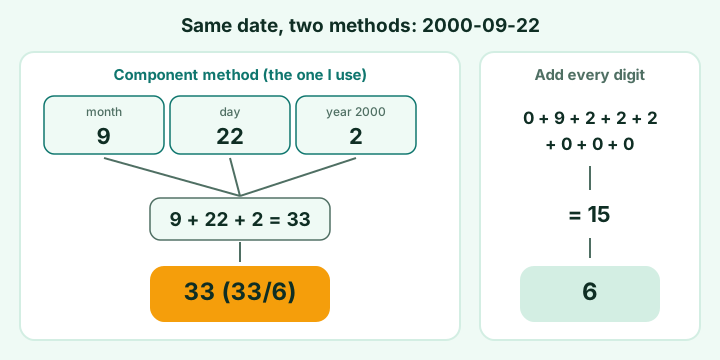
Compound numbers and master numbers
The total you reach before the last reduction is the compound number. I always write it down, because it shows how you got there: 20 → 2 is a different route from 11 → 2, even though both end on a 2. The three master numbers, 11, 22 and 33, are written with their base digit after a slash: 11/2, 22/4, 33/6. The base digit is a companion, not a replacement. The answer is still 33.
| Total | Result | Written as | What happened |
|---|---|---|---|
| 10 | 1 | 10/1 | Digits added once |
| 20 | 2 | 20/2 | Digits added once |
| 29 | 11 | 29/11 | Stops at the master 11, base digit 2 |
| 33 | 33 | 33/6 | Master kept, base digit 6 |
| 38 | 11 | 38/11 | 3 + 8 = 11, stops there |
| 44 | 8 | 44/8 | Not a master; 4 + 4 = 8 |
Only 11, 22 and 33 are kept. 44 and every higher double-digit total reduces fully, which is why I will never call a 44 a life path number.
Where master numbers are kept, and where they are not
| Step | Keeps | Example |
|---|---|---|
| Month | 11 only | November stays 11; October becomes 1 |
| Day | 11 and 22 | The 22nd stays 22; the 29th stays 11; the 31st gives 4 |
| Year (digit sum) | 11 and 22 | 1993 gives 22; 2009 gives 11 |
| Final total | 11, 22 and 33 | 9 + 22 + 2 = 33 stays 33; 44 becomes 8 |
The 33 can only ever appear in the last step, because no month, day or year digit sum reaches it. That is why a calculator that reduces the day and year to a single digit first can never return 33, however many dates you try. In my count of every date over almost a century, the component method lands on 11 for 6.41% of dates, on 22 for 3.15% and on 33 for 0.80%.
Why a life path number calculator can give a different answer
There are three common behaviours, and a site rarely tells you which one it uses:
- Component method with masters kept, the one above.
- Add every digit in one pass. Write out all the digits of the month, day and year, add them, and reduce the total, stopping at 11, 22 or 33.
- Reduce everything to 1–9. Some calculators drop the masters altogether and say so; one well-known example states this openly.
| Date | Component | All digits | Masters dropped |
|---|---|---|---|
| 2000-09-22 | 33 | 6 (15) | 6 |
| 2000-11-09 | 22 | 4 (13) | 4 |
| 1951-05-26 | 2 (20) | 11 (29) | 2 |
| 1949-06-22 | 33 | 33 | 6 |
The 1951 line is the classic case, and the source I trust for the component method shows it too: 5 + 8 + 7 = 20 gives 2, while 5 + 2 + 6 + 1 + 9 + 5 + 1 = 29 gives 11. In my count, the two methods disagree for 12.81% of dates, roughly one in eight, so you will meet the disagreement sooner than you expect.
My choice is the component method. The day and the year can each carry a master number of their own, and the one-pass sum throws that information away before you ever see it. Pick one method and use it for everyone you compare; a pair of numbers from two different methods means nothing. The life path number calculator on this site shows the component result and the all-digits result side by side, so you can see which branch your date takes.
Five dates worked from start to finish
| Date | Month | Day | Year | Total | Life path | All digits |
|---|---|---|---|---|---|---|
| 2000-09-22 | 9 | 22 | 2000: 2 | 9 + 22 + 2 = 33 | 33 | 15 → 6 |
| 2000-11-09 | 11 | 9 | 2000: 2 | 11 + 9 + 2 = 22 | 22 | 13 → 4 |
| 1975-11-29 | 11 | 29 → 11 | 1975: 22 | 11 + 11 + 22 = 44 → 8 | 8 | 35 → 8 |
| 1988-02-29 | 2 | 29 → 11 | 1988: 26 → 8 | 2 + 11 + 8 = 21 → 3 | 3 | 39 → 12 → 3 |
| 1990-07-20 | 7 | 20 → 2 | 1990: 19 → 10 → 1 | 7 + 2 + 1 = 10 → 1 | 1 | 28 → 10 → 1 |
Take 1988-02-29 slowly, because it shows three habits at once. The month is 2. The day 29 gives 2 + 9 = 11, and you stop at 11. The year gives 1 + 9 + 8 + 8 = 26, then 8. The total is 2 + 11 + 8 = 21, and 2 + 1 = 3. A 29th of February exists only in a leap year, meaning a year divisible by 4, except century years not divisible by 400. Check that before you trust a date.
Slips that change the answer
- Reducing the day or year too early. Turning 22 into 4 turns 2000-09-22 into 9 + 4 + 2 = 15, then 6, and the 33 disappears.
- Reducing November to 2. It makes 2000-11-09 come out as 2 + 9 + 2 = 13, then 4, instead of 11 + 9 + 2 = 22.
- Keeping 44. A total of 44 is not a master number. It becomes 8.
- Replacing a master with its base digit. A final 33 is reported as 33/6, not as 6.
- Mixing methods between two people. Compare like with like or not at all.
- Using the wrong date. I use the date on the birth certificate and do not shift it for time zones.
How to check any calculator in two minutes
- Enter 2000-09-22. A correct component calculator answers 33. A 6 means it either adds every digit or reduces the day and year first.
- Enter 1951-05-26. A 2 means components, an 11 means all digits. If you got 6 in the first test and 2 here, the masters are being dropped.
- Enter 2000-11-09. The answer should be 22, with 11 + 9 + 2 in the working. A 4 means November is being reduced.
- Enter 1975-11-29. The answer must be 8, not 44.
- Look for the working. A calculator that shows only the final digit cannot be audited, and I do not rely on it.
Once the arithmetic is settled, the interesting part starts: what each life path number means and how to read two numbers together.
Questions and answers
Do I add the year as one number or digit by digit?
Add its four digits and keep reducing until one digit is left, stopping at 11 or 22. 2000 gives 2, 1993 gives 22, and 1990 gives 19, then 10, then 1.
Should I reduce 11, 22 and 33 to a single digit?
No. In the component method they are kept as the answer and written with a base digit, such as 33/6. Reducing them is a different convention, used by calculators that drop master numbers entirely.
What does a number like 29/11 mean?
It is the compound number followed by the result: the three parts add to 29, and 2 + 9 = 11, which is kept as a master number. The base digit of 11 is 2.
Is 44 a master number?
In the standard component method it is not. A total of 44 reduces to 8, so a date such as 1975-11-29 has a life path number of 8.
Why did another website give me a different life path number?
Most likely it uses the all-digits method, which differs from the component method for about one date in eight, or it reduces everything to 1-9. Check it with 2000-09-22: the component method gives 33.