Life Path Number Calculator with Every Step Shown
Enter a birth date and this life path number calculator works out your number the way a numerologist writes it, keeps master numbers 11, 22 and 33, and checks it with a second method.
Life path number calculator
Pick a birth date to see the number, every step of the sum, both common methods side by side and the personal year.
Your result
The working
Two methods, one date
What the number stands for
Personal year
Add a partner’s birth date to place both numbers on the compatibility chart.
Two dates on the chart
Recent dates
Kept only in this browser’s storage; it never leaves your device.
The life path number calculator above takes one birth date and returns the number I start every reading with, written out the way I write it on paper: each part of the date reduced, the total, and any master number shown as 11/2, 22/4 or 33/6. A second common method runs beside it, so you see why another site may disagree. Below the result the sum is also drawn as a short path, with the month, day and year leading to your number.
Numerology is a traditional belief system, not a science. I use the life path as a prompt for reflection on temperament and habits, never as a forecast or a diagnosis.
How to calculate your life path number in four steps
This is the component method, the one I teach and the one behind the headline result. Use the date as it was recorded where you were born.
- Reduce the month. January to September stay as they are; October is 10 → 1 + 0 = 1; December is 12 → 3. November is 11 and stays 11.
- Reduce the day. Add the digits until one remains, but stop at 11 or 22: 19 → 10 → 1, 29 → 2 + 9 = 11 (kept), 22 stays 22.
- Reduce the year. Add its four digits and keep reducing, again stopping at 11 or 22: 1990 → 19 → 10 → 1, while 1993 and 1975 both give 22.
- Add the three results and reduce the total. Keep 11, 22 or 33; anything else goes down to one digit. A total of 44 is not a master: 4 + 4 = 8.
Two dates worked through in full:
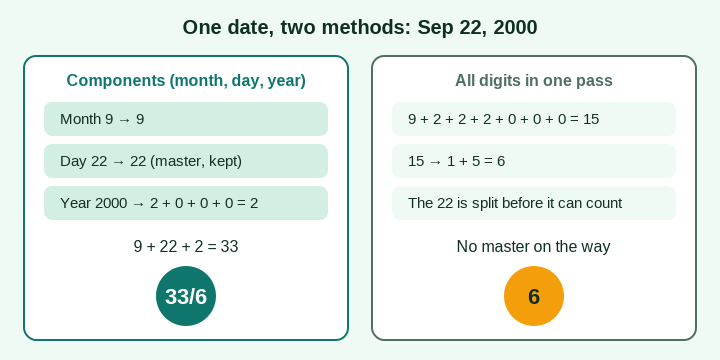
Month 9 → 9 · Day 22 → 22 (kept) · Year 2 + 0 + 0 + 0 = 2
9 + 22 + 2 = 33 → life path 33/6
Month 7 → 7 · Day 20 → 2 + 0 = 2 · Year 1 + 9 + 9 + 0 = 19 → 1 + 9 = 10 → 1
7 + 2 + 1 = 10 → 1 + 0 = 1 → life path 1
I always write the total before the arrow because it carries information: a total of 38 becomes 3 + 8 = 11, noted 38/11. The calculator uses the same notation, so you can check it line by line.
Why life path calculators give different answers
When two sites disagree about your number, it is rarely an arithmetic error; they follow different rules. The usual split is between components and adding every digit in one pass. The classic example, from a component-method reference:
Components: 5 + (2 + 6 = 8) + (1 + 9 + 5 + 1 = 16 → 7) = 20 → 2
All digits: 5 + 2 + 6 + 1 + 9 + 5 + 1 = 29 → 2 + 9 = 11
It runs the other way too. On Sep 22, 2000 the components give 33, while the one-pass sum is 9 + 2 + 2 + 2 = 15 → 6, because the 22 is broken up before it can count.
Older shortcuts add to the confusion. Some calculators reduce the day and year to one digit before adding, so 22 becomes 4 and a 33 can never appear. Some turn November into 2: Nov 9, 2000 then gives 2 + 9 + 2 = 13 → 4 instead of 11 + 9 + 2 = 22. And a few reduce everything to 1–9 and say so, which is fine as long as it is stated.
In my count of every date over almost a century (35,064 birth dates), the component method and the one-pass method disagree on 12.81% of them, roughly one in eight. My rule: I read the component result, because it treats month, day and year as three separate cycles, and I note the one-pass number beside it when it differs. The calculator does the same.
Master numbers 11, 22 and 33
A master number is kept only at the points named above: 11 in the month, 11 and 22 in the day and the year, and 11, 22 or 33 in the final total. Read 11 as an intensified 2, 22 as an intensified 4 and 33 as an intensified 6; that is why I write them 11/2, 22/4 and 33/6. Because a total of 11 is kept, 2 is the rarest single digit by components (4.71% of dates): many would-be 2s stop at 11.
| Master number | Component method | All digits in one pass |
|---|---|---|
| 11/2 | 6.41% | 8.56% |
| 22/4 | 3.15% | 2.95% |
| 33/6 | 0.80% | 4.70% |
By components a 33 is genuinely rare, under one date in a hundred; a one-pass calculator hands it out nearly six times as often.
What each life path number means
The compact version I give after a first session. Treat each line as a question to ask yourself, not a label.
| Number | Keyword | Strengths | Habit to watch |
|---|---|---|---|
| 1 | Initiative | Starts things, decides fast, works well alone | Going it alone when help is on offer |
| 2 | Partnership | Listens, mediates, notices what others miss | Keeping the peace at the cost of your own view |
| 3 | Expression | Words, humour, ideas that lift a room | Scattering energy across too many projects |
| 4 | Structure | Patience, method, finishing what you start | Holding on to a plan after it stops working |
| 5 | Freedom | Adapts quickly, learns by doing, loves variety | Leaving just before the payoff |
| 6 | Care | Responsibility, home, fixing what is broken | Taking on everyone’s problems as your own |
| 7 | Inquiry | Depth, research, a quiet and exact mind | Withdrawing instead of saying what you need |
| 8 | Results | Organises people and money, plays the long game | Measuring your worth only by output |
| 9 | Completion | Generosity, a wide view, letting go gracefully | Giving until there is nothing left for you |
| 11/2 | Intuition | The 2 with a sharper inner signal and a talent for inspiring others | Nervous tension; set firm limits on input |
| 22/4 | Large-scale building | The 4 with ambition for work that outlasts you | Pressure to be extraordinary; build in steps |
| 33/6 | Teaching through care | The 6 turned towards guiding and teaching | Over-responsibility; care for yourself first |
Comparing two birth dates
Add a second date and the calculator works out both life paths, gives the pair a short reading and shows the full symmetric 9 × 9 chart with their cell highlighted: 2 with 6 reads the same as 6 with 2. The digits fall into three families, a convention of public compatibility charts, which are symbolic by nature:
- Natural: same family (1-5-7, 2-4-8 or 3-6-9). Shared rhythm and priorities.
- Complementary: the traditional cross-family pairs 1 & 3, 3 & 5, 7 & 9, 2 & 6, 4 & 6 and 6 & 8. Each fills the other’s gaps.
- Challenging: every other pair. Different pace; it works with deliberate effort.
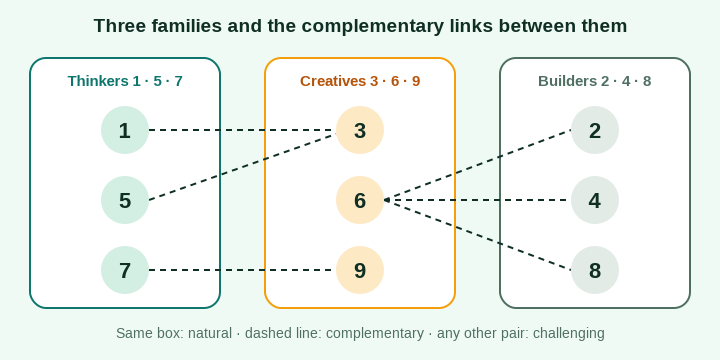
A worked pair: Sep 22, 2000 is a 33, which sits on 6; Jul 20, 1990 is a 1. Cell 6 and 1 is challenging. A 6 tends to show love through care, a 1 through independence, so the useful conversation is about how much help each of you actually wants. A challenging cell is a topic to talk about, never a verdict, and no chart should tell anyone to stay or leave.
Your personal year number
The personal year describes the stretch of the road you are on now. Add the digits of your birth month, your birth day and the current calendar year, then reduce to a single digit. Masters are not kept here, because the cycle runs 1 to 9.
Month 9 · Day 2 + 2 = 4 · Year 2 + 0 + 2 + 6 = 10
9 + 4 + 10 = 23 → 2 + 3 = personal year 5
In short: 1 starts things, 2 builds partnerships and patience, 3 favours expression, 4 is for groundwork, 5 brings change, 6 turns to home and duty, 7 to study and rest, 8 to results, and 9 clears the way for the next cycle. The arrows beside the personal year in the calculator step to the previous or next year and show where each one falls in the nine-year cycle.
What the life path number calculator does, and how I test it
The rules are the ones on this page, applied in a fixed order: month kept at 11; day and year kept at 11 or 22; total kept at 11, 22 or 33, anything else reduced to 1–9. The second method adds all digits of month, day and four-digit year in one pass and keeps the same three masters. Years from 1800 are accepted, future dates are refused, and February 29 is checked against the year, so an impossible date gets a message, not a wrong number.
Besides the number you get every step of the sum, a meaning in four panels (strengths, habits to watch, work, relationships) with the note from the top of this page, and buttons to copy the result as text, copy a share link or print it.
Everything runs in your browser: a share link keeps the date after the # sign, which is never sent to a server, and recent results stay on your device with a button to clear them. Every version is tested against control dates I worked out by hand and rechecked separately:
| Birth date | Component steps | Life path | All digits |
|---|---|---|---|
| Sep 22, 2000 | 9 + 22 + 2 = 33 | 33/6 | 15 → 6 |
| Nov 9, 2000 | 11 + 9 + 2 = 22 | 22/4 | 13 → 4 |
| 5/26/1951 | 5 + 8 + 7 = 20 → 2 | 2 | 29 → 11 |
| Nov 29, 1975 | 11 + 11 + 22 = 44 → 8 | 8 | 35 → 8 |
| Feb 29, 1988 | 2 + 11 + 8 = 21 → 3 | 3 | 39 → 12 → 3 |
| Nov 11, 2009 | 11 + 11 + 11 = 33 | 33/6 | 15 → 6 |
| Jun 22, 1949 | 6 + 22 + 5 = 33 | 33/6 | 33 (kept) |
| Oct 19, 1993 | 1 + 1 + 22 = 24 → 6 | 6 | 33 (kept) |
| Jul 20, 1990 | 7 + 2 + 1 = 10 → 1 | 1 | 28 → 10 → 1 |
| Jan 1, 1800 | 1 + 1 + 9 = 11 | 11/2 | 11 (kept) |
If your own sum differs, compare the day line first: 22 and 29 trip most people up.
Keep going
Questions and answers
How do I calculate my life path number?
Reduce the month, the day and the year of your birth date separately, keeping 11 and 22 where they appear, then add the three results and reduce the total, keeping 11, 22 or 33. Sep 22, 2000 gives 9 + 22 + 2 = 33.
Why do different calculators give me a different life path number?
Most disagreements come from the method: reducing the parts first versus adding all digits in one pass, and whether master numbers are kept or reduced early. The two common methods disagree on roughly one birth date in eight.
Is 11 a life path number or 2? Should I reduce master numbers?
In the method I use, a final 11 stays 11 and is written 11/2: read it as a 2 with more intensity. Some systems reduce every master to one digit; neither is wrong, but a calculator should say which it uses.
How rare is life path 33?
By the component method about 0.8% of birth dates give 33, compared with 6.4% for 11 and 3.2% for 22. Calculators that add all digits in one pass give 33 far more often, close to 5% of dates.
Which life path numbers are compatible?
Numbers in the same family (1-5-7, 2-4-8, 3-6-9) are traditionally called natural matches, with a few cross-family pairs called complementary. The chart is symbolic: use it to start a conversation, not to judge a relationship.
What is the difference between the life path and destiny (expression) number?
The life path comes only from your birth date. The destiny or expression number comes from the letters of your full birth name, each converted to a number and reduced in the same way.
Guides
 How to Calculate Your Life Path Number by HandFour steps with a pencil, where master numbers are kept, five worked dates, and why calculators disagree.7-minute read
 Life Path Numbers 1 to 9: Meanings, Strengths and Blind SpotsStrengths, blind spots, work style and one useful habit for each life path number, plus 11, 22 and 33.7-minute read
 Life Path Compatibility Chart: How to Read Two NumbersThe full 9 by 9 chart, the three families, what each level means day to day, and one worked pair.6-minute read
Updated · About this site