Life Path Compatibility Chart: How to Read Two Numbers
A life path compatibility chart takes two life path numbers and tells you how their rhythms tend to meet: in step, complementary, or needing deliberate effort. Below is the full nine-by-nine chart I use, how it is built, what each level means in daily life, and one pair worked from two birth dates. Read it as a set of questions to talk through, never as a verdict on anyone.
Numerology is a tradition, not a science. I treat the numbers as prompts for reflection, never as predictions, and I would not use a reading to decide anything about health, money or a relationship.
How the life path compatibility chart is built
Every chart like this is symbolic, which is easy to forget when a score is printed next to it. One public chart says plainly that its ratings are prompts for conversation, not probabilities, and I follow the same approach. Mine has no scores at all: it has three levels, and it works in three moves.
- Find both life path numbers with the component method, the same one for both people. The pencil method takes a minute.
- Swap each master number for its base digit. 11 becomes 2, 22 becomes 4, 33 becomes 6. The master keeps its own label in the reading, but the grid has nine rows.
- Look up the pair. The chart is symmetric: 3 with 5 is the same cell as 5 with 3, so it never matters whose number you read first.
The full chart
| 1 | 2 | 3 | 4 | 5 | 6 | 7 | 8 | 9 | |
|---|---|---|---|---|---|---|---|---|---|
| 1 | Nat | Chal | Comp | Chal | Nat | Chal | Nat | Chal | Chal |
| 2 | Chal | Nat | Chal | Nat | Chal | Comp | Chal | Nat | Chal |
| 3 | Comp | Chal | Nat | Chal | Comp | Nat | Chal | Chal | Nat |
| 4 | Chal | Nat | Chal | Nat | Chal | Comp | Chal | Nat | Chal |
| 5 | Nat | Chal | Comp | Chal | Nat | Chal | Nat | Chal | Chal |
| 6 | Chal | Comp | Nat | Comp | Chal | Nat | Chal | Comp | Nat |
| 7 | Nat | Chal | Chal | Chal | Nat | Chal | Nat | Chal | Comp |
| 8 | Chal | Nat | Chal | Nat | Chal | Comp | Chal | Nat | Chal |
| 9 | Chal | Chal | Nat | Chal | Chal | Nat | Comp | Chal | Nat |
Nat is natural, Comp is complementary, Chal is challenging. Of the 45 distinct pairs, 18 are natural (that includes each number paired with itself), 6 are complementary and 21 are challenging. About half of all pairings land on the challenging level, which is the first reason not to read it as a warning.
The three families
Numerology traditions group the numbers into families, and the chart rests on them. The 1-5-7 family is independent and restless: starting, moving, questioning. The 2-4-8 family is practical and grounded: relationships, structure, results. The 3-6-9 family is expressive and caring: creativity, home, service.
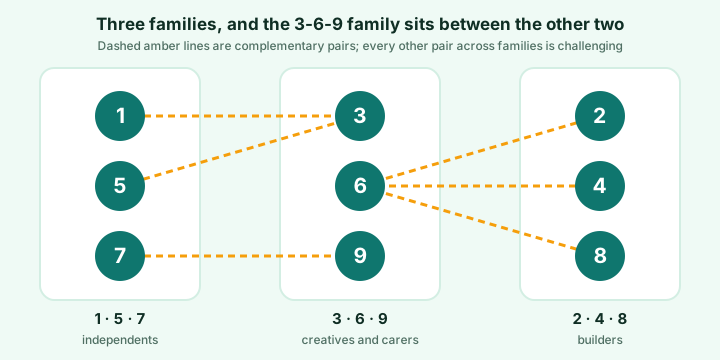
One pattern is worth noticing: no number in the 1-5-7 family is complementary with any number in the 2-4-8 family. Every connection between those two goes through 3, 6 or 9, so the 3-6-9 family is the bridge. In my reading, people in that family often act as translators in a mixed household.
What each level means in everyday terms
| Level | What it tends to feel like | What to watch | One useful habit |
|---|---|---|---|
| Natural | Shared pace and priorities; plans come easily | Both people leaning the same way and missing the same blind spot | Ask what neither of you is seeing |
| Complementary | Each supplies what the other lacks | Taking the other's strength for granted | Say out loud what you value in the difference |
| Challenging | Different speed and different first instincts | Misreading a difference as disinterest | Agree how you will decide, before you need to |
The tradition describes a natural pair as easy and a challenging pair as hard work. Real relationships are not that tidy. Two people from the same family can amplify each other's habits, and two from different families often succeed because the difference forces them to talk. The level tells you where to look, not what you will find.
A worked pair: 2000-09-22 and 1990-07-20
The first date gives 9 + 22 + 2 = 33, a master number with base digit 6. The second gives 7 + 2 + 1 = 10, then 1. In the grid that is the pair 6 and 1, and the chart marks it challenging. A 6 tends to care for things and to carry them; a 1 tends to decide and to move. What I would talk about:
- Help versus independence. When the 6 offers help, is it wanted, or does it feel like being managed?
- Who decides, and how. The 1 may decide fast, the 6 may want everyone consulted. Agree which decisions belong to whom.
- Standards at home. A high bar for how things are kept can feel like criticism to a partner who wants to get on.
- Rest. The 6 needs permission to put the load down; the 1 needs room to start something alone.
Nothing in that list says the pair will struggle. It says where two sensible people would need an honest conversation.
Master numbers in the chart
The 33 above was read as a 6, and the same rule applies to the others. A pair of 33 and 9 reads as 6 with 9, which is natural. A pair of 11 and 8 reads as 2 with 8, which is natural too. Two master numbers read through their base digits, so 11 and 22 become 2 and 4, a natural pair. When a master is involved I read the pair twice, once through the base digits and once with the master's intensity in mind, then keep what is useful.
Why a challenging cell is not a verdict
Because almost half of all pairs fall into the challenging level, a rule that said "avoid these" would rule out close to half of all pairings. I do not use the chart to say yes or no to a relationship, and neither should you. It is a tradition for starting a conversation, and it can be wrong in any particular case.
If you want your own pair, enter two dates in the life path number calculator: it works out both numbers with the steps, marks the cell on the chart and gives a short reading. Meanings of each number are in the guide to numbers 1 to 9.
Questions and answers
Which life path numbers are most compatible?
In my chart the natural pairs are numbers in the same family: 1, 5 and 7; 2, 4 and 8; and 3, 6 and 9. Complementary pairs, such as 1 with 3 or 6 with 8, are traditionally a good fit too. These are symbolic readings, not measurements.
How do master numbers work in a compatibility chart?
Each master is read through its base digit: 11 as 2, 22 as 4 and 33 as 6. The master keeps its own label, but the chart has only nine rows and nine columns.
Is a challenging pair a bad match?
No. Challenging means different pace and different first instincts, which takes deliberate conversation. About half of all pairs are in this level, and the chart cannot say how any one relationship will go.
Does it matter which number I read first?
No. The chart is symmetric, so 3 with 5 is the same cell as 5 with 3.