Life Path Numbers 1 to 9: Meanings, Strengths and Blind Spots
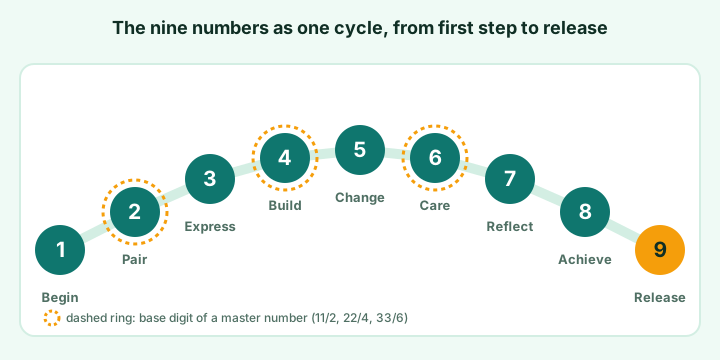
The life path number is the single digit, or master number, that comes out of a birth date, and in numerology it is read as a way of approaching life rather than a fate. Here are the nine numbers in plain language, with strengths, the blind spots I see most often, how each one tends to work, and a short section on the master numbers 11, 22 and 33.
Numerology is a tradition, not a science. I treat the numbers as prompts for reflection, never as predictions, and I would not use a reading to decide anything about health, money or a relationship.
If you have not worked out your number yet, the life path number calculator does it in a second and shows the steps; the pencil method takes a minute.
The nine life path numbers at a glance
| Number | Keyword | Strength | Habit to watch |
|---|---|---|---|
| 1 | Initiative | Starting things, self-reliance | Going it alone, impatience |
| 2 | Cooperation | Listening, tact, patience | Over-accommodating, avoiding conflict |
| 3 | Expression | Communication, humour, warmth | Scattering energy, skipping the dull part |
| 4 | Structure | Reliability, method, follow-through | Rigidity, overwork |
| 5 | Change | Adaptability, curiosity | Restlessness, dropping commitments |
| 6 | Care | Responsibility, loyalty, a sense of home | Carrying other people's problems |
| 7 | Inquiry | Analysis, depth, independent thought | Withdrawing, over-thinking |
| 8 | Results | Organisation, drive, a feel for scale | Measuring worth by achievement |
| 9 | Completion | Generosity, a wide view | Giving too much, finding it hard to let go |
How I read a life path number
I ask three questions of any number: what drives it, what it does well, and what habit to watch. The third question matters most. Almost every description online lists strengths only, which is flattering and not much use. A blind spot, described as a habit rather than a flaw, is something you can actually act on.
Keep the scale in mind too. A birth date puts you in one of nine boxes, and millions of people share each box. Treat the number as a pattern you may or may not recognise in yourself. If a description does not fit, drop it and keep the rest.
Life path numbers 1 to 9 in detail
1: the starter
A life path 1 tends to want to begin things and to be the one who decides how. The strengths are initiative, directness and a willingness to go first when nobody else will. The blind spot is impatience: other people can look slow, and asking for help can feel like losing ground. At work this number does best with a clear area of its own and room to act. What helps is finishing someone else's idea once in a while and listening before the plan is fixed.
2: the partner
A life path 2 tends to work through other people, by listening, mediating and sensing what a room needs. The strengths are tact, patience and the ability to hold two points of view at once. The blind spot is agreeing to keep the peace and then resenting it later, or waiting to be asked instead of speaking. At work it shines in roles built on trust: coordination, support, negotiation, teaching one to one. What helps is naming one preference out loud every day, however small.
3: the voice
A life path 3 tends to express: words, jokes, images, ideas that want an audience. The strengths are warmth, humour and an ease that makes other people feel they can talk. The blind spot is spreading across too many projects and avoiding the repetitive stretch every craft contains. At work it suits anything where communication is the product: writing, teaching, design, hosting. What helps is a fixed, small routine that makes the unglamorous part automatic.
4: the builder
A life path 4 tends to build slowly and well, one dependable layer at a time. The strengths are reliability, a sense of method and the patience to follow a job to the end. The blind spot is rigidity: a plan that worked becomes the only plan, and rest feels like waste. At work it does well in craft, planning, finance, engineering and anything where details decide the outcome. What helps is scheduling a deliberate change of method now and then, and treating rest as part of the job.
5: the traveller
A life path 5 tends to learn by moving: new places, new people, new skills. The strengths are adaptability, curiosity and being calm when plans collapse. The blind spot is restlessness: leaving at the first friction, or treating commitment as a cage. At work it likes variety and autonomy: travel, sales, consulting, anything with a changing brief. What helps is choosing one long commitment on purpose and keeping the freedom inside it.
6: the carer
A life path 6 tends to look after things: a home, a team, a family, a standard of quality. The strengths are loyalty, warmth and a dependable sense of responsibility. The blind spot is taking on problems that belong to someone else, and holding a very high bar for everyone, yourself included. At work it fits teaching, health support, hospitality and community roles. What helps is asking, before helping, whether help was wanted.
7: the seeker
A life path 7 tends to ask why: it analyses, researches and wants to understand before it acts. The strengths are depth, independent judgement and a gift for spotting what does not add up. The blind spot is retreating into thought when a conversation or a decision is what the situation needs. At work it suits research, engineering, writing, diagnostics and any solitary, careful craft. What helps is sharing a half-formed opinion on purpose, before it is polished.
8: the organiser
A life path 8 tends to think in terms of results, resources and scale. The strengths are drive, a feel for organisation and comfort with responsibility for outcomes. The blind spot is equating worth with achievement, or controlling a project so tightly that nobody else can contribute. At work it suits management, business, law, logistics and anywhere that rewards judgement about people and money. What helps is defining success in a few measures that are not about output.
9: the finisher
A life path 9 tends to take the wide view: causes, communities, the bigger story. The strengths are generosity, compassion and an ability to see a situation from many sides. The blind spot is giving until nothing is left, or holding on to something that has ended. At work it suits teaching, healing, the arts and mission-driven work. What helps is closing chapters deliberately: finish, thank, release, and begin the next one.
Master numbers 11, 22 and 33
When the component method ends on 11, 22 or 33, the number is kept and written with its base digit: 11/2, 22/4, 33/6. In my count of every date over almost a century, 11 turns up for 6.41% of dates, 22 for 3.15% and 33 for 0.80%, so 33 is the rarest by a wide margin.
| Number | Base | Reading | What to watch |
|---|---|---|---|
| 11/2 | 2 | The cooperation of a 2, turned up: heightened sensitivity and a pull towards inspiring others | Nervous tension; set small routines to settle it |
| 22/4 | 4 | The method of a 4, turned up: the wish to build something large and lasting | Pressure to do it all at once; build in stages |
| 33/6 | 6 | The care of a 6, turned up: a strong urge to look after and teach | Giving more than the situation asks; keep limits |
A master number is not a better number. Many people with an 11, 22 or 33 find the base digit describes their daily life well and the master only appears at particular moments. Read both and keep what fits. The longer story of master numbers and karmic debt is a separate topic, and I keep it short here.
Using your number without leaning on it
- Read your number and its blind spot first. The strengths you already know.
- Pick one habit from the "what helps" line and try it for a month.
- Notice what fits. Keep a short note of the moments where the description was right or wrong.
- Drop what does not fit. A tradition is a tool for reflection, not a verdict.
- Compare, if you like. To see how your number sits beside a partner's, use the compatibility chart.
Questions and answers
What does my life path number mean?
It is read as a tendency in how you approach life: what drives you, what you do well and which habits to watch. It is a tradition for reflection, not a prediction or a personality test.
Is life path 11 the same as 2?
Not quite. 11 is kept as a master number and read as an intensified 2. It is written 11/2, and many people find both readings useful.
Which life path number is the rarest?
By the component method, 33. In my count of every date over almost a century it appears for about 0.8% of dates, against about 3.2% for 22 and 6.4% for 11.
Can two people with the same life path number be very different?
Yes. Millions of people share each number, and upbringing, choices and temperament shape a person far more than a digit does. Use the description as a prompt, not a label.